A young Muslim couple, Aisha and Ahmed, were sitting with their families, excited about their upcoming nikah. But soon, a common question arose: “How much should the Mahr be?” Some relatives suggested a high amount to match social standards, while others reminded them of the Sunnah. Confused, they began to wonder: How to Decide a Reasonable Mahr in Islam?
This is a question many Muslim families face today. Between cultural pressure and religious guidance, finding the right balance can feel difficult. Yet, Islam has already provided a clear and beautiful framework to determine a fair Mahr (Islamic dowry), one that reflects respect, simplicity, and genuine commitment.
In this guide, we’ll explore step-by-step how to set a reasonable Mahr amount according to the Quran and Sunnah. so every marriage can begin with barakah (blessing), not burden.
Table of Contents
What is Mahr in Islam?
Mahr is a mandatory gift that the groom gives to the bride at the time of Nikah. It is not a “price” for marriage but a token of respect, honor, and responsibility.
Allah ﷻ commands in the Quran:

“And give the women [upon marriage] their bridal gift graciously. But if they, of themselves, choose to remit any part of it, then take it in satisfaction and ease.”

(Surah An-Nisa 4:4)
This verse shows two important points:
- The bride has full ownership of her Mahr.
- It must be given willingly and respectfully, not as a burden or forced transaction.
How to Decide a Reasonable Mahr in Islam: Step-by-Step
1. Begin with the Right Intention
Before discussing numbers, set the niyyah (intention). Mahr is about honor and love, not bargaining or showing off. As a couple, remind each other: “We want a Mahr that brings blessings, not burdens.”
2. Check Affordability (for the Husband)
Islam does not demand extravagance. The husband should calculate his income, expenses, debts, and savings before deciding. The key is:
- Not too high → that it pushes him into debt.
- Not too low → that it undermines the bride’s dignity.
3. Discuss Early (Not Last Minute)
Don’t leave Mahr negotiations until the Nikah day. Discuss it during engagement to avoid conflict or delays.
- A student or early-career groom might agree on a modest, deferred Mahr.
- A professional with stable income may comfortably commit more.
Tip: Keep the tone warm and collaborative, not transactional.
4. Take Inspiration from the Sunnah (Not Pressure)
The Prophet ﷺ encouraged simplicity in Mahr. In some marriages, it wasn’t gold or silver—it was teaching Quranic verses. This doesn’t mean every Mahr must be symbolic today. The real lesson is that Mahr should not be a burden or status symbol. Islam values moderation, sincerity, and balance.
5. Consider Mahr al-Mithal (Community Norms)
Traditionally, Mahr al-Mithal means giving an amount similar to what other women in the family or community received. But remember! it’s a reference, not a rule. If culture demands excessive amounts, prioritize the Quran and Sunnah over social pressure.
Ask yourself: “If this amount delays our marriage or puts us in debt, is it truly Islamic?”
6. Choose the Form of Mahr
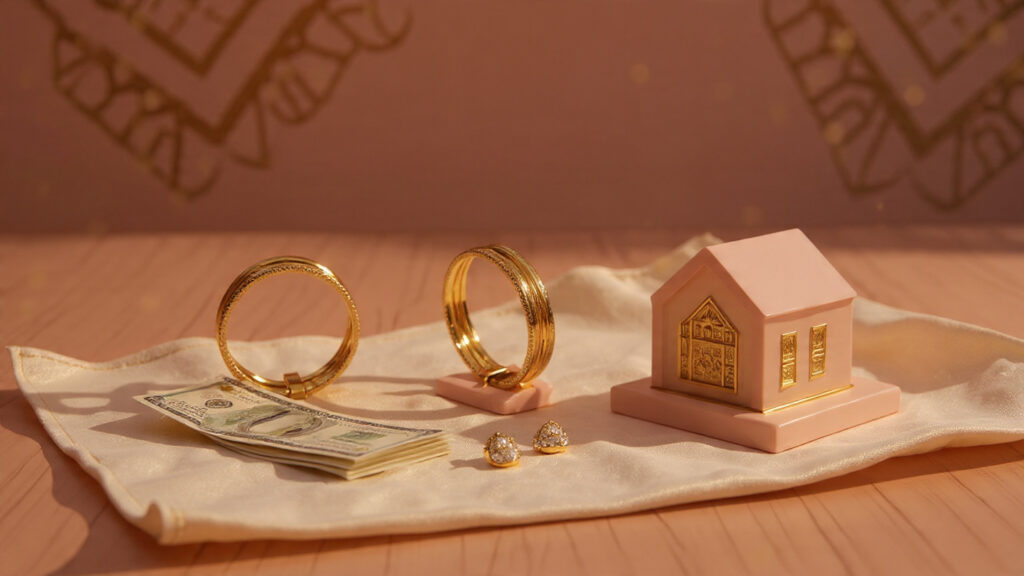
Mahr can be:
- Cash (a fixed amount)
- Gold or Silver (measured in grams/coins)
- Property or assets (land, a house, etc.)
7. Decide the Structure: Immediate or Deferred
Mahr can be divided into:
- Mu‘ajjal (immediate): Paid at the time of Nikah.
- Mu’akhkhar (deferred): Payable later, when agreed upon.
Deferred Mahr can reduce pressure on newlyweds while still ensuring security for the bride.
8. Keep it Symbolic, Not Competitive
Mahr is meant to honor the bride, not measure her worth in money. Avoid turning it into a “prestige contest.” If the agreed number causes stress or disputes, reduce it. A smaller, sincere gift carries more blessing than a showy burden.
9. Record it in the Nikah Contract
Always document the details:
- Exact amount/value
- Type (gold, money, property)
- Payment terms (immediate or deferred)
Writing it in grams of gold helps protect against inflation.
10. Stay Firm Against Outside Pressure
Relatives may push for more or less. But Islam prioritizes the mutual consent of the couple, not the crowd. If pressured, respond politely: “We’ve agreed on a simple, Sunnah-based Mahr that suits our situation.”
11. Respect Consent and Gratitude
- The bride’s consent is essential.
- Any reduction or waiver must be voluntary, never forced.
- The husband should fulfill his promise happily, as Allah ﷻ instructs in Surah An-Nisa 4:4.
12. Begin with Dua and Blessings
Seal the agreement with dua for love and barakah. Keep the initial Mahr manageable; future gifts and generosity can always be added as Allah ﷻ blesses your marriage.
Practical Tips for Couples
- Balance culture with Islam – Use customs as a guide, not a burden.
- Prioritize respect, not materialism – Even a small but meaningful gift can carry great value.
- Discuss openly – Avoid misunderstandings by communicating early.
- Stay realistic – Don’t let Mahr delay your marriage goals (like saving for a home).
- Resist comparisons – What others gave should not define your choice.
- Avoid ostentation – Don’t let Mahr become a financial competition.
- Avoid debt – Islam discourages unnecessary borrowing for Mahr.
- Stay flexible – If needed, the bride may reduce or waive part of the Mahr (voluntarily).
- Keep Sunnah above culture – If cultural expectations are excessive, return to Quran and Sunnah.
- Appreciate it with gratitude – For the bride, receiving Mahr with a thankful heart increases blessings.
Conclusion: Start Marriage with Barakah, Not Burden
So, how to decide a reasonable Mahr in Islam? The answer lies in intention, balance, and sincerity. A Mahr that is affordable, meaningful, and agreed upon by both partners, while guided by the Quran and Sunnah, will invite blessings into the marriage.
The Prophet ﷺ reminded us: “The best marriage is the one that is easiest.” (Ibn Majah 1847)
By keeping Mahr simple, respectful, and free of cultural excess, couples can begin their new life together with peace, dignity, and the barakah of Allah ﷻ.
Frequently Asked Questions (FAQs) About Mahr in Islam
1. What is the minimum Mahr in Islam?
There is no fixed minimum amount of Mahr in Islam. It can be as little as a simple gift, like a ring, or even teaching a Surah of the Qur’an, as mentioned in Hadith. The key is that it should be something valuable in the eyes of the bride.
2. Is Mahr always money or gold?
Not necessarily. While money and gold are common forms of Mahr, Islam allows it to be anything lawful, beneficial, and agreed upon, like land, property, jewellery, or even knowledge.
3. Can Mahr be waived?
Yes, after the marriage, if the bride willingly and happily chooses to forgo part or all of her Mahr, it is allowed (Qur’an 4:4). But at the time of Nikah, Mahr must be stipulated.
4. Can Mahr be paid later?
Yes. Mahr can be divided into Mu’ajjal (immediate) and Mu’akhkhar (deferred). The deferred Mahr is paid later, but it remains a debt upon the husband until fulfilled.
5. Does Islam encourage high Mahr?
No. The Prophet ﷺ discouraged heavy demands and said the best marriage is the one with the easiest and most affordable Mahr. Simplicity brings barakah (blessing).